ServicesWater softeners
Water Softeners in Fort Worth, After a Hardness Test
We test your water before we talk about a softener. If the hardness is high enough to cause scale, we size a unit to your home and how much water you use. After it's running, we come back to check the settings and show you how to keep it working.
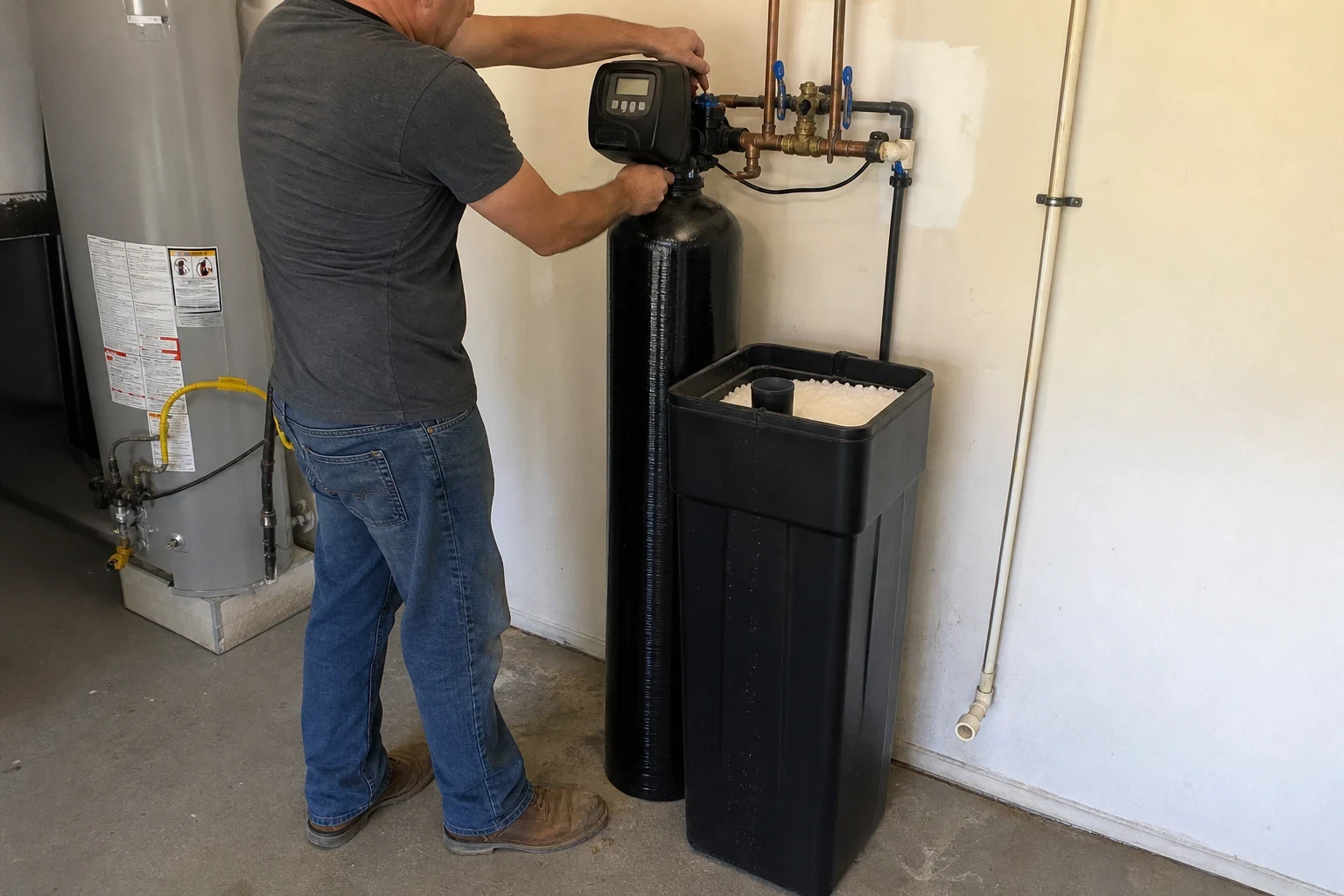
Why a hardness test comes before any softener
As water passes through rock and soil, it picks up calcium and magnesium. Heat it or let it dry on a surface and those minerals settle out as chalky spots on fixtures, cloudy glasses and buildup inside the water heater. A softener runs the water through a tank of resin beads that trade those minerals for sodium or potassium. It won't touch chlorine, lead or sediment; carbon filters or reverse osmosis take care of those.
No two homes have quite the same hardness, and a hunch shouldn't put a tank in your garage. We test at your faucet and hand you the reading in grains per gallon. A low number means we tell you a softener isn't worth it and suggest what could help. A high number means we show you the unit size that matches.
Our work keeps going after the first cycle. A few weeks in, we come back, retest the softened water and check how much salt it's using. Then we go over the handful of monthly tasks that are yours.
What the softener job includes
Hardness test at your tap
We test a cold water sample on site and write down the result. If iron shows up, we test for that too, since iron can foul softener resin and changes what you need.
A right-sized unit
Three things set the size: the grains per gallon from your test, how many people live in your home and how much water you go through in a day. An undersized tank regenerates constantly. An oversized one is money spent on capacity you never use.
Tie-in at the main supply
We connect the softener where water enters your home, often by the water heater or in the garage, and add a bypass valve so you can take it out of the loop. We run the drain line and connect the brine tank. Outdoor hose bibs can stay on hard water so you don't spend salt on the lawn.
Settings and first regeneration
We program the control valve to your test result and household size. Then we run a regeneration while we're there to make sure the brine draw and drain both work.
Follow-up visit
A few weeks later we check back. We test the softened water, look at the salt level and adjust the settings if the unit is using more salt than it should.
Care notes you keep
We leave written notes on which salt to buy, how often to check the brine tank, how to break up a salt bridge and how to use the bypass.
Clues your water could be hard
Scale on faucets and shower heads
A white, chalky ring forms around aerators, spray nozzles and glass doors. You scrub it off with vinegar and it returns within weeks.
Haze on glassware
Glasses leave the dishwasher with white spots or a dull film, and rinse aid doesn't fix it.
Thin lather and soap film
You go through more shampoo to get suds, and a gray film clings to the tub and to your skin after a shower.
Water heater noise
Popping or rumbling from a tank water heater can mean scale has settled on the bottom. Tankless units may need descaling more often than the manual says.
Parts wearing out early
Faucet cartridges and toilet fill valves stick or fail sooner than they should.
An old softener nobody understands
If a softener came with the house and no one knows its settings, a test tells you if it still works or if you need it at all.
How a softener job goes
- 1
Test and talk
We test your water, look at where the main line comes in and explain what the numbers mean. You get a written estimate with each item listed.
- 2
Install day
Most installs take part of a day. The water is off for a stretch while we cut into the main line, so plan showers and laundry around it. We put down drop cloths and clean up before we leave.
- 3
Set up and confirm
We program the valve, fill the brine tank, run a regeneration and test water at a tap to confirm it's soft.
- 4
Check back
After a few weeks we follow up on salt use and run another test. If something's off, we adjust it then.
What moves the price of a softener
We don't price a softener until we've tested your water and seen where it will go. The cost depends on the size your numbers call for and how much plumbing it takes to get it in. You'll see every item on the written estimate before we start.
- Your number and your family
- The harder the water and the bigger the household, the more resin it takes. That means a larger tank and a heavier-duty valve.
- Where the main line is
- A main line that's easy to reach in the garage costs less to tie into than one in a tight closet. Older galvanized pipe may need a section replaced to connect cleanly.
- Drain and power
- The unit needs a drain and, for most valves, an outlet nearby. If neither is close, we have to run them.
- Pre-treatment
- Iron or grit in the test results can clog the resin bed over time, so we may add a separate filter upstream of the softener. Our iron and sediment filtration page covers that.
- Valve type
- Metered valves that regenerate on actual use cost more than timer models but usually use less salt and water.
Softener questions we hear
Something not covered here? (817) 552-5599
Do I need a softener in Fort Worth?
Maybe. Some homes have real scale problems and others barely notice. That's why we test first. If your number is low, we'll tell you to skip it.
Will softened water taste salty?
Most people can't taste it. How much sodium ends up in the water depends on your starting hardness. If you want to keep it out of drinking water, under-sink reverse osmosis at the kitchen sink strips most of it out. Another option is filling the brine tank with potassium chloride in place of regular salt.
Does a softener remove chlorine or lead?
No. A softener handles hardness minerals and small amounts of iron. For chlorine taste, look at whole-house carbon filtration. For lead from old plumbing, reverse osmosis at the drinking tap is the better fit, and our water testing page covers what we can check.
How much upkeep is there?
Check the salt about once a month and top it off when it's below half. Watch for a hard crust in the brine tank, called a salt bridge, and break it up with a broom handle. We go over this at the follow-up visit, and our filter replacement and maintenance service can take it off your hands.
Can it go in the garage?
Usually, if the main line runs through or near it. The unit needs a drain and power close by. North Texas does get hard freezes, so we check whether the spot needs insulation.
Find out your hardness number first
We'll test your water and tell you straight if a softener makes sense. If it does, we install it and come back to check on it.